G-FEST '26: Reigniting the Atomic Spark by the Power of the Kaiju Writing Community.
Another year, another journey to the hallowed grounds of Rosemont, Illinois for the biggest Kaiju convention of the year, G-FEST. The biggest celebration of all things giant monster, and what’s come to be my favorite yearly outing. Having said that, I was coming into the con a bit less enthused than last year.
2025 was a banner year for me. I completed and published my best novel to date, my love letter to the Kaiju genre, ONE MASSIVE STEP. By this time last year I had completed my very first Book Tour, going from Kaiju Brooklyn to Dover Con and finally landing in G-FEST for my last stop. And so, I thought, creatively, I’d be in an even better place this year, with ONE MASSIVE STEP’s sequel. However, in the time since last G-Fest, I’d really been struggling. I’ve never written a sequel to any of my previous works – none that made it to print, anyhow, and the weight of my own raised standards, self-doubt, and plain old writer’s block left me with only most of the first chapter of ONE MASSIVE STEP’s sequel, TWO GIANT CRIES.
While I adored the movie marathon at the Pickwick Theater on Thursday, I couldn’t help but dwell on this worry that I’d stagnated as an author and made no measurable progress. Yet, on Friday, that began to change. I attended the Kaiju Writers Unite! Panel, a question-and-answer session where notable independent Kaiju authors fielded aspiring creators’ questions. Before the panel, Donny Winter, poet and collaborator, spoke to me, and told me he was glad to see me there. It was a small thing, but it really made a difference. Not only that, but several of the other panelists, Nathan Marchand (author of Destroyer and dozens of short stories) and Cristofer Nigro (owner of indie publishing house Wild Hunt Press) recognized me and praised the work I did at last year’s Writing Workshop, which went on to be published in Wild Hunt Press’ Attack of the Kaiju Volume 3: Giants on the Rampage.
Despite all of that happening last year, it took me until now to realize – my work is getting noticed.
Saturday was the day I really settled in for what I enjoy the most about G-Fest – the panels and community events. First stop was an interview with Dr. Jeffrey Angles, the man who translated the novelizations of Godzilla and Godzilla Raids Again for American readers back in 2023, and just last month, translated The Luminous Fairies and Mothra, the novella that inspired the 1962 Kaiju classic, Mothra. As an author myself, I was keen to sit in on this interview and see just what goes into translating these stories.
Dr. Jeffrey Angles’ interview was facilitated by Donny Winter (famed poet whom I mentioned before) and Dr. Joyce Boss, Franklin I. and Irene List Saemann Chair in World Communities at Wartburg College. Dr. Angles explained that his own Kaiju literary journey began in 2020, when he, like the rest of us, was stuck at home in quarantine. He found the original novelization of Godzilla written by Shigeru Kayama, and decided to translate it for fun. He approached University of Minnesota Press with his work, and they agreed there was a market for it. They couldn’t have been more right, as the book would launch the same year Godzilla Minus One hit theaters and, to quote Dr. Angles directly: “Sold like CRAZY.”
In a first for the small publishing house, fans wrote to the University of Minnesota press asking for The Luminous Faires and Mothra to be translated. Fan demand brought the novella stateside this year. As a part of his translation process, Dr. Angles did a lot of research into the original story of Mothra, which began by examining the novella’s three authors – Shinichiro Nakamura, Takehiko Fukunaga and Hotta Yoshie. Nakamura was considered a more “highbrow author”, being best known for writing about the struggles of surviving World War II. Fukunaga was a more “modern author”, introducing European literary trends to Japanese work, but it was Yoshie that fascinated Dr. Angles the most. Hotta Yoshie was an outspoken anti-war activist and was repulsed by the idea of allying with America or Russia after what happened in World War II. Yoshie believed that the Japanese people would be better served if they allied themselves with “underdeveloped countries”, such as Vietnam or South Korea.
Yoshie’s firm political views come forth in The Luminous Fairies and Mothra, in the form of villainous country Rusilica – literally a portmanteau of Russia and America. Current events also loomed heavy over the original story. In 1960, Japan was in a state of unrest thanks to the renewal of the treaty between America and Japan. As Dr. Angles explained, this came to a head with the Anpo Protests. On May 19th, 1960, Prime Minister Kishi held a meeting of the Diet to vote on ratifying the US-Japan Security Treaty when only members of the government Kishi knew would vote in his favor were present. In protest, Japanese citizens organized a massive sit-in, which was stopped when the PM had every one of them arrested. This was a direct violation of Article 21 of the Japanese Constitution, passed May 3rd, 1947, which guarantees the people of Japan freedom of speech, press and assembly. Kishi then forced the US-Japan Security Treaty to a vote, which passed. This widely controversial move sparked more political violence, like the June 15th Incident, a mass protest that led to a protracted, bloody conflict inside the Diet Building.
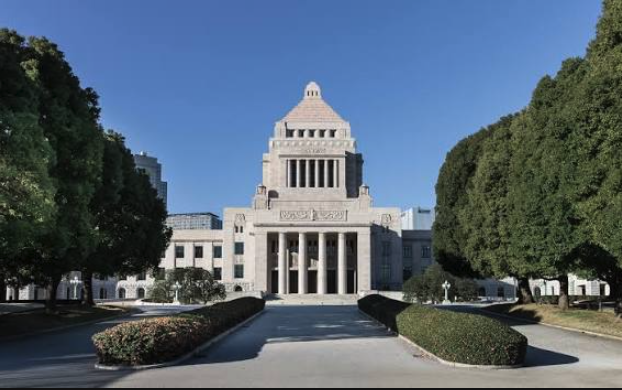
National Diet Building - 1-7 Nagatacho, Chiyoda-ku, Tokyo
It was this political climate that birthed the novella The Luminous Fairies and Mothra, in which a foreign government’s involvement in Japan’s affairs sparks mass protests. In the original Novel, Mothra actually attacks and cocoons herself on the Diet Building, in a parallel to the June 15th Incident. When the novella was adapted into a film by Toho, they deliberately toned down the political parallels, and Mothra attacked Tokyo Tower instead of the Diet Building, making Mothra’s attack less of a political statement, and more of a symbol of the monster attacking the progress Japan had made since WWII (For reference, Tokyo Tower’s construction had only been finished three years ago at the time of the movie’s release). All of this cultural knowledge was completely new to me, and I never would have known had I not attended this Interview.
Other interesting differences between the novella and the film is that there’s a creation myth that comes from Mothra’s home of Infant Island, and that in the book, she is explicitly a god. Moreover, Mothra, despite being the most famous female Kaiju, is never consistently gendered in her original story, with the original Japanese work using both “he” and “she” pronouns, depending on the stage of life Mothra is in. Dr. Angles retained this in his translation, effectively making Mothra transgender! It was fascinating to hear about the origins of one of the most iconic Kaiju around, and Dr. Angles even revealed some upcoming novels he’d be working to translate – Rodan and Matango, two more classic stories from Toho! I for one, can’t wait to read them. Dr. Jeffrey Angles’ dedication to authenticity, immersive research, and the majesty of the Kaiju genre is something I deeply respect.
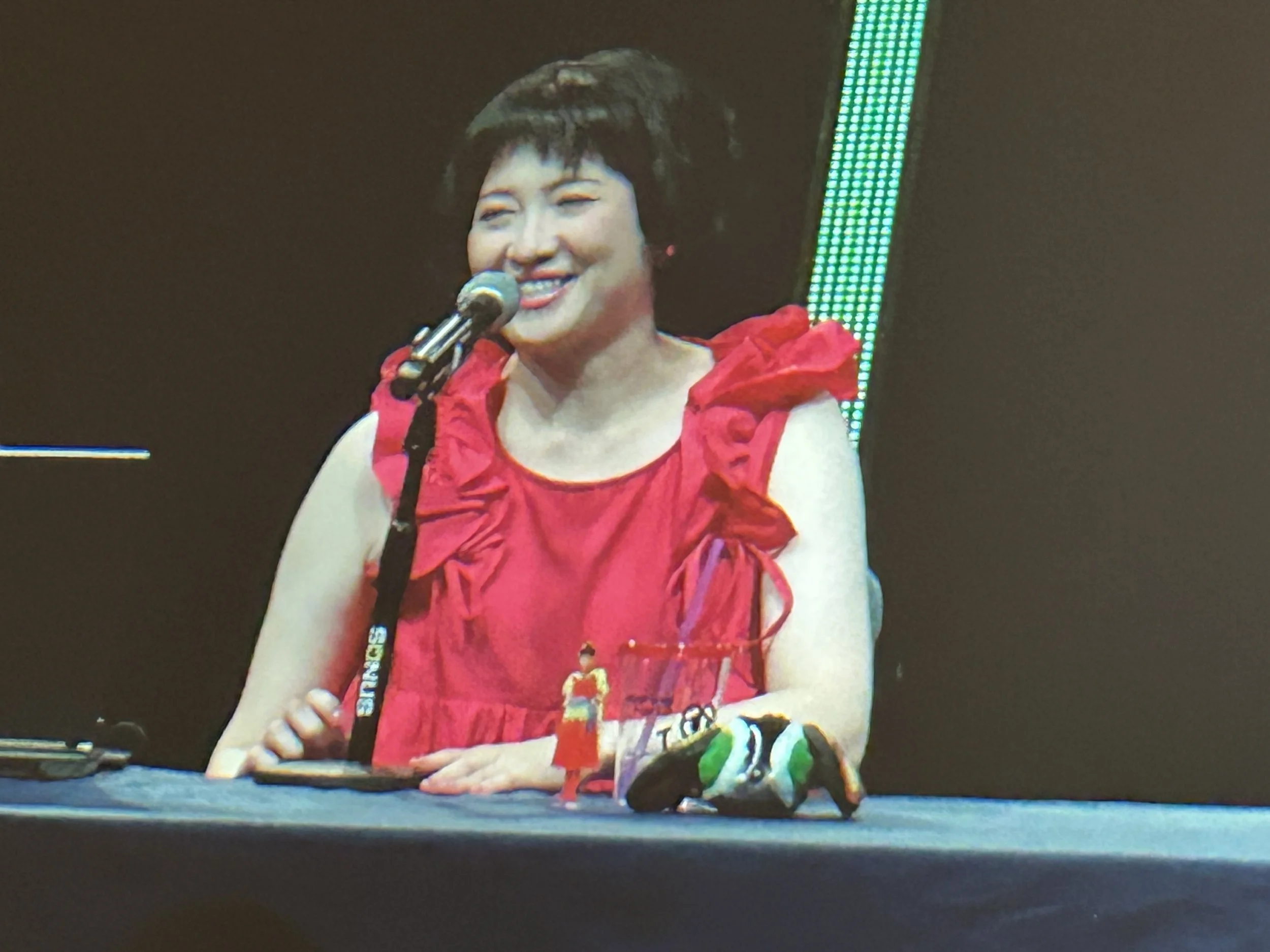
Megumi Kobayashi
The next Interview I sat in on was with Megumi Kobayashi, star of the Rebirth of Mothra film trilogy. Megumi played Moll, one of the twin fairies that would pray to Mothra and speak on her behalf. The interview at G-Fest was facilitated by Kevin and Amanda Derendorf, Kaiju cinema historians. During the interview, Ms. Kobayashi explained that she was first inspired to pursue acting and entertainment after her older sister was scouted to be a model. The two girls modeled together before Megumi moved on to acting, beginning her career by doing commercials for KFC. Ms. Kobayashi explained being a child actor was tough on her, as she’d have to work on her days off, couldn’t go on school trips, and found it difficult to make friends because of how busy she was. However, Megumi explained that playing Moll really helped her, as playing such a hopeful, positive character was a boost to her mental health at 18.
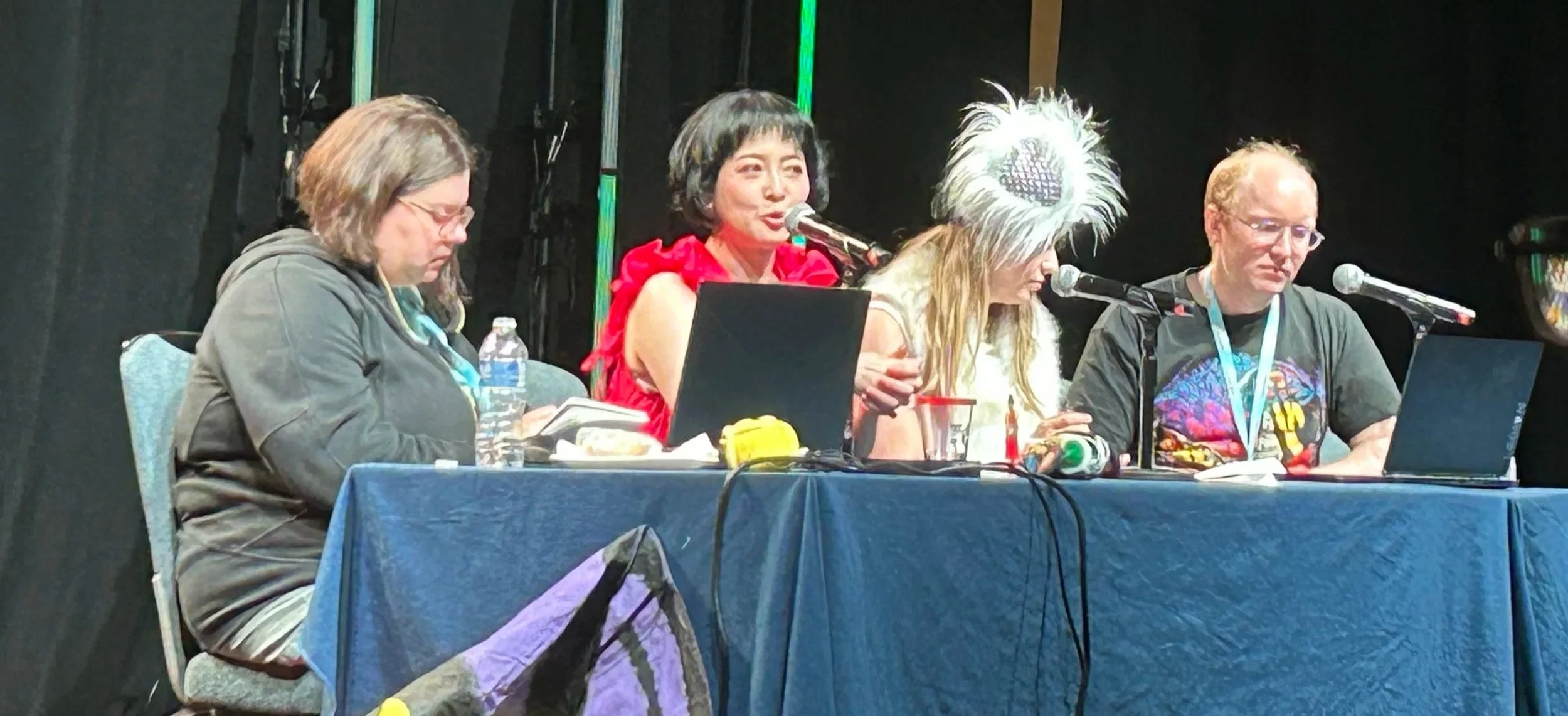
Megumi Kobayashi interview (Left to right: Megumi’s Translator, Megumi Kobayashi, Amanda Derendorf, Kevin Derendorf)
When acting as Moll, Ms. Kobayashi was acting almost entirely in front of a green screen, and only ever met two of the cast members. It was a challenge for her as a lot of her job was acting and reacting to things that weren’t there. Acting in a Mothra film was very fulfilling for Megumi, as her father used to sing Mothra’s song to her as a child, so to see where the song came from and how famous it was meant a lot to her.
Megumi Kobayashi was an actress until she turned 26, at which point she shifted gears and became a singer. Ms. Kobayashi has said that she’s always chosen to do what’s fun, and that’s defined her career. And, after seeing her in person, I believe it. Megumi Kobayashi is a bubbly, wonderfully positive person who continues to bring joy to thousands of people across the world.
The last activity of note I did at this year’s G-FEST was attending the 2nd annual Writer’s Workshop, hosted by Daniel DiManna, Nathan Marchand, and Christofer Nigro, with special appearances by Donny Winter and other independent Kaiju Authors. Last year, I had managed to write and submit a short story in about four hours thanks to the dedicated workshop time we had. This year however, we writers did not have dedicated panel time to write and had to do it on our own time. Rather than scrambling to write something, I elected to bring in a piece that I’ve been struggling with for over a year now – the first chapter of TWO GIANT CRIES, which I’ve been writing and rewriting over and over again practically since the first book was sent off to the printers. Self-doubt, second guessing myself, and all sorts of negativity had been bogging me down, to the point where I’d been paralyzed to write any further. So, I brought the writing to the Workshop, in hopes that the outside opinions there could give me the perspective I needed to move forward. And, to my surprise, those who heard what I’d written had nothing but nice things to say! According to them, I didn’t need to rewrite or change a thing – just keep writing.
Not only that, but after all of us had shared and peer reviewed our work, Christofer Nigro made an exciting announcement: everyone who attended the Writer’s Workshop at G-FEST would be published by Wild Hunt Press! It seems my short story last year started a trend, as Chris announced a new anthology – Kaiju Terror: New Voices of Doom, a publication explicitly dedicated to publishing exciting new voices in the Kaiju medium! Not only that, but Chris also announced a new quarterly magazine he and his fellow panelists would be bringing to life soon – Kaiju Planet, a spiritual successor to the now ended G-FAN Magazine, will have Issue 0 going live on Amazon in the near future. After that, there will be a Kickstarter campaign to bring the magazine to life!
Everyone who was brave and bold enough to share their stories left the Workshop knowing that they’d be a published author. I can tell you from experience, there’s few feelings better than that. It’s that kind of positivity and kindness that truly elevates the Kaiju community into something I’m proud to be a part of. It’s that community, that joy, that will keep me coming back to G-FEST again and again.